

By the middle of October the pumps start coming out of the ground. Hiring a water feature contractor in Colorado Springs, CO has less to do with how a waterfall photographs in July and more to do with what happens to it between the first hard freeze and the spring restart.
Above 6,000 feet the cold arrives early, stays late and swings thirty degrees inside a single afternoon, and almost every decision made down in the ground is an answer to that.
Matt Hiner founded Hiner Outdoor Living in 2008 with almost 10 years of experience in the landscape industry, and the company holds Aquascape certification for ponds and water features. The ponds and waterfalls that come through February without a service call are rarely the most elaborate ones. They are the ones where the shutdown was drawn into the design before anybody set a boulder.
This guide covers what winterizing a feature actually involves, how frost depth and altitude change the excavation and the plumbing, what a pondless basin asks for compared with a stocked pond, where ice does its damage, and what to settle with any contractor before the ground is opened.
Related: Colorado Springs, CO: Gourmet Outdoor Kitchen Meets Serene Water Fountain for Epic Home Entertaining
What Does Winterizing a Water Feature in Colorado Springs Involve?
Winterizing a water feature in Colorado Springs involves less dismantling than most homeowners expect and far more sequencing. The rock, the liner and the basin stay exactly where they are, while the pump comes out and the water level comes down, so that nothing is left standing in a line or a housing where it freezes solid and splits it open.
On a pondless waterfall the sequence is short. The pump is pulled and stored submerged in a bucket of water so its seals do not dry out and crack, the check valve is opened, the plumbing is drained or allowed to run back into the basin, and the autofill is shut off at the valve rather than at the timer.
A stocked pond runs the opposite way. It is not drained, because the fish overwinter in the deepest water, and the aim through the cold months is a single clear opening in the ice for gas exchange rather than a dry system. That opening is held with a floating de-icer, an aerator set deliberately shallow, or both together.
What Fall Work Comes Before Winterizing a Water Feature?
Netting comes before winterizing, and it goes on before the leaves drop rather than after.
Leaves that sink and break down under ice pull oxygen out of the water through a season when nothing is circulating to correct it, and lifting a net in November is a far smaller job than clearing a winter of sludge in April. Our water feature maintenance visits are timed around leaf drop for exactly that reason.
The same visit is when small faults get found while they are still small. A skimmer gasket that has gone hard, a liner fold holding water or a fitting weeping slightly under the rock is a ten-minute item in October and a much larger one once it has been through a winter of freeze and thaw.
How Does Frost Depth Change a Water Feature Excavation?
Frost depth sets the floor for everything buried in a water feature excavation. Plumbing that holds water through winter has to sit below the frost line or be pitched so it drains back dry on its own, and along the Front Range that is a real depth rather than a token one, so a line run flat and left charged is the most common way a new feature fails in its first January.
Basin and pond depth answer the same arithmetic for different reasons. A pondless reservoir needs enough volume below the freeze zone that the pump intake stays in liquid water through a long cold stretch, while a pond carrying fish needs enough depth that a stable unfrozen layer remains at the bottom however thick the surface ice gets.
Soil decides what that excavation costs in effort. Much of the ground around Colorado Springs is decomposed granite over clay, with cobble and bedrock turning up without much warning, and a boulder set that reads as straightforward on paper becomes a very different day once the machine is in the hole.
That is why the dig gets quoted against what is genuinely under the lawn rather than against an average. Our pond construction work starts with that assessment, because a basin shortened on the day to clear rock is a basin that struggles in its first hard winter.
Why Does Altitude Change Water Feature Equipment?
Altitude changes water feature equipment because thinner air changes how a pump behaves and how hard the sun works. At elevation there is less atmospheric pressure available on the suction side, so priming and lift are less forgiving than the identical unit installed near sea level, and a pump sized tightly against its head height has very little margin left to give.
Ultraviolet intensity climbs sharply with elevation, and it is relentless on anything left exposed. Liner showing above the waterline, flexible tubing routed above grade and plastic fittings sitting in direct sun all age faster here than the catalog figures suggest, so covering them properly is a build decision rather than a maintenance one.
The freeze-thaw count matters more than the lowest temperature on the record. A Front Range winter delivers bright afternoons above freezing and nights well below, over and over through the season, and it is that repeated cycling rather than any single cold night that works joints loose, lifts set rock and opens a seam in a seal.
Why Do Front Range Water Features Need More Water Than Expected?
Front Range water features need more water than expected because evaporation at altitude is high and the dry winter winds take more than most people allow for.
A reservoir sized to the minimum runs low during exactly the windy, sunny stretches when nobody is out checking it, and a pump that gulps air for an afternoon is a pump at real risk of failing that week.
Autofill solves this, provided the autofill itself is isolated and drained in October. A feed line that does not shut off cleanly becomes its own freeze risk, which is why it is routed and valved at the planning stage rather than added once the stone is in place.
Where Does Ice Do the Damage on a Water Feature?
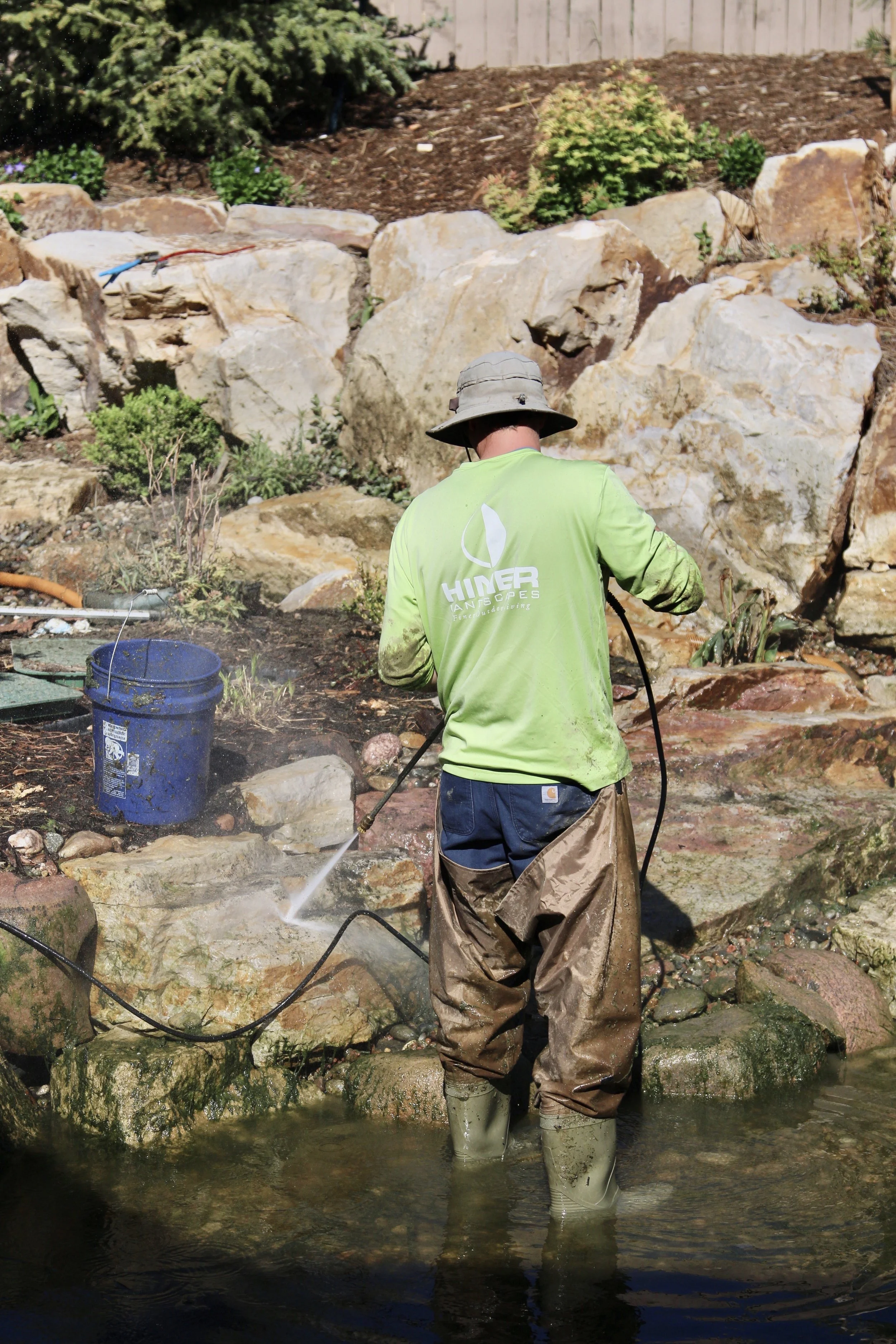
Ice rarely damages the stone on a water feature. Damage concentrates at the pump, the plumbing, the liner edge and the skimmer face, which are precisely the places where water gets trapped with nowhere to expand, and water held inside a closed check valve or sitting in a low spot in a flex line finds the weakest fitting in the system and opens it.
The failure that costs the most is an ice dam on a feature left running. Ice builds at the weir and along the stream edges, water backs up behind it and finds a path over the liner instead of down the channel, and the basin empties overnight into the surrounding soil, leaving the pump running dry for hours by morning.
That is the specific reason a feature kept running through winter has to be designed for it and watched. Features built to run cold need generous liner height at the edges, a deliberate path for ice to form without diverting flow and somebody checking the water level through the cold stretches, and our waterfalls and fountains account for that at the design stage.
Everything else is cheaper to put right. A split fitting, a cracked pump housing or a torn liner fold is a spring repair, and each one is avoidable by draining what ought to be dry and leaving in place what ought to stay wet.
Related: Creating a Relaxing Escape With a Swimming Pool & Water Features in Northgate, CO
What Does a Pondless Waterfall Ask For That a Pond Does Not?
A pondless waterfall asks for a different winter than a pond. It carries no fish and no biological load through the cold, so it shuts down completely, sits dry and waits until spring, and for a property that empties out over the winter months, or an owner who travels, that simplicity is the entire argument.
It does ask for honest reservoir volume. All the water in the system has to live somewhere once the pump stops, and a basin sized tightly to the brochure figure is the one that runs short in its first dry, windy February.
A stocked pond is a living system with a winter routine attached to it. Depth, aeration, netting and a de-icer are the price of carrying fish through a Colorado winter, and the reward is a feature that stays alive under the ice rather than going quiet for five months.
Neither option is the better one in the abstract. The choice follows how the household actually uses the yard in January, and it is worth making deliberately rather than inheriting it from whatever the contractor builds most often.
What Happens to Water Feature Planting Through Winter?
Water feature planting follows its own calendar through winter, and it runs ahead of the hard cold. Hardy lilies get cut back and moved to the deepest shelf where the crown sits below the ice, and marginal plants are trimmed so that dying foliage is not left to rot in the water through a season with no circulation to carry it away.
Tender plants are a separate decision made in September rather than November. Tropical lilies and floating plants do not survive a Front Range winter outdoors, so they are either lifted and overwintered somewhere frost-free or treated as an annual expense and replaced each spring.
The planting around the feature matters just as much as the planting in it. Deciduous trees set upwind of a pond fill it every fall for the next forty years, and that is a siting decision taken at the drawing stage, when moving a feature twenty feet costs nothing at all.
What Should Be Settled Before a Water Feature Breaks Ground?
Access should be settled first, before a water feature breaks ground. Once the rock is set and the planting is in, the pump, the valves and the autofill either remain reachable or they do not, and a feature that requires lifting a two-hundred-pound boulder to change a pump has made every future visit harder than it needed to be.
Responsibility for the shutdown comes next. Winterization is either included in the build, sold as a seasonal visit or left with the homeowner, and all three arrangements work perfectly well as long as the answer is known in October rather than discovered in December.
Then comes power and water. A dedicated circuit with ground fault protection, placed where it is actually reachable in winter, and an autofill tied to a line that is itself isolated and drained are small items at the planning stage and awkward retrofits afterward.
Finally, settle how the feature is meant to be used in winter. A feature built to run cold is built differently than one built to sleep, and that question gets answered before the excavation is laid out rather than after the stone is set.
What Five Questions Should You Ask a Water Feature Contractor?
Ask a water feature contractor how deep the buried plumbing sits and whether it drains back on its own, and what volume the reservoir actually holds once the pump stops. Then ask who pulls the pump in the fall and whether that visit is quoted, how the pump is reached after the rock is set, and what happens to the feature if the household is away for three weeks in January.
A contractor who answers all five without reaching for a catalog has built for this climate before. One who treats the questions as fussy detail has probably been building features that photograph well in June and get a service call in February.
Plan the Shutdown With a Water Feature Contractor in Colorado Springs, CO
A water feature is a piece of structure and plumbing sitting in ground that freezes hard and early at this elevation, and the parts that decide how it runs in five years are settled before a single stone is placed.
Our team would rather read the soil, work out the frost depth, plan the drain-back and agree who handles the shutdown first.
Build a water feature for the Front Range climate with Hiner Outdoor Living. Schedule your water feature consultation with Hiner Outdoor Living.
In Summary
Can a water feature be built in Colorado Springs, CO once the ground has frozen?
Excavation for a water feature in Colorado Springs, CO generally waits until the ground thaws, because frozen ground is slow and costly to open and backfill placed in those conditions compacts poorly. Most winter inquiries become design and planning work with the dig booked for spring, and starting in winter means the site assessment, the layout and the equipment list are finished before the season opens and the calendar fills.
Does a pond have to be shut off completely over the winter?
A stocked pond stays running over the winter rather than shutting off completely. Fish overwinter in the deepest water and need one opening kept clear in the ice so gases exchange, which a floating de-icer or an aerator set shallow handles. A pondless waterfall is the opposite case, and Hiner Outdoor Living drains it, shuts it down and leaves it dry until spring with no attention needed.
How long does a water feature build take once the design is agreed?
The excavation and rock setting on a typical backyard water feature takes a matter of days, and everything around it sets the rest of the schedule. Utility locates, machine access through a side gate, boulder delivery, electrical work and the planting that follows all add time, so a feature needing a new circuit run and boulders craned into a tight yard is a materially longer job than a pondless basin beside an existing patio.
Related: Enhancing Your Landscape With a Pond in Colorado Springs, CO
